
Climate change is neither a distant concept nor exclusive to melting glaciers and the Amazon basin; it is directly felt across our city streets. In a country as geographically diverse as Ecuador, global warming does not impact every population in the same way. Understanding these localized differences is essential to protecting families and ensuring sustainable development across communities.
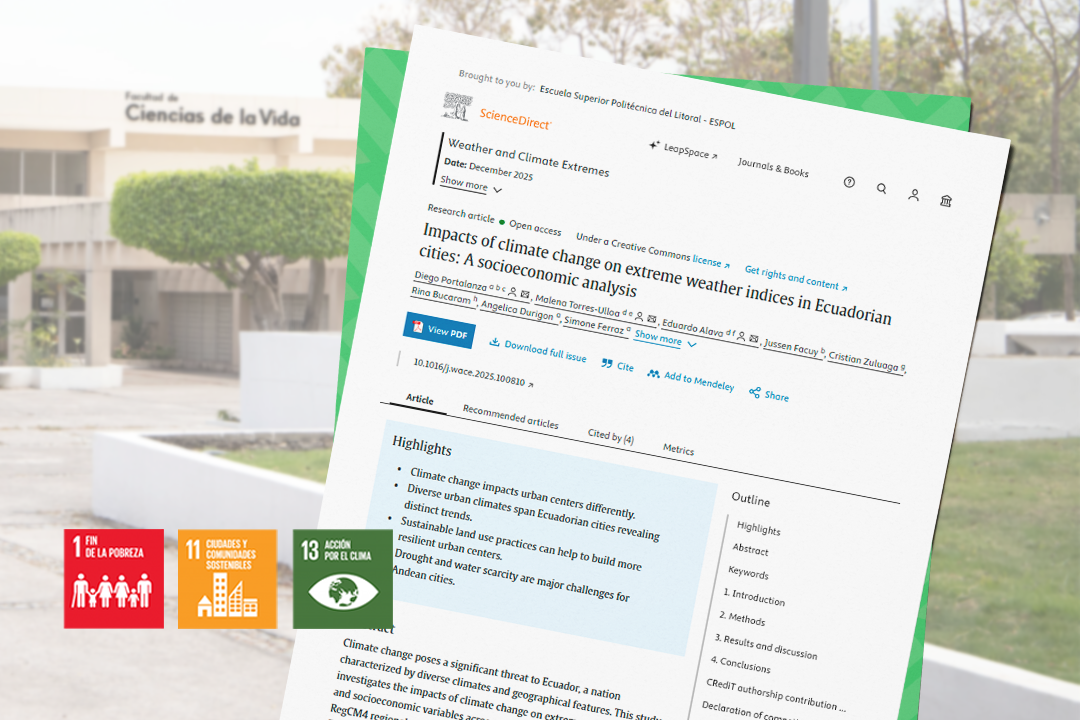
To address this challenge, researchers and faculty members from the Faculty of Life Sciences (FCV) at ESPOL, Malena Torres and Eduardo Álava, contributed to a multidisciplinary study titled “Impacts of climate change on extreme weather indices in Ecuadorian cities: A socioeconomic analysis,” published in Elsevier's international journal Weather and Climate Extremes.
Rising Heat, Longer Droughts, and Fewer Cold Nights
The study evaluated the evolution of extreme weather events over four decades and projected future scenarios across nine key Ecuadorian cities. Regional climate models identified clear and consistent long-term trends:
- Increase in Consecutive Dry Days: Extended dry spells without rainfall are expanding, intensifying water scarcity—a challenge that is particularly acute for Andean urban centers.
- Longer Warm Spells: Warm spell duration indicators show a continuous upward trend across the evaluated areas.
- Decline in Cold Nights: Minimum nighttime temperatures have steadily increased over the past 40 years, altering urban thermal comfort and public health dynamics.
Climate and Socioeconomic Vulnerability: A Critical Link
A central contribution of this research is that it moves beyond reporting shifts in temperature and rainfall by integrating machine learning (via Random Forest models) with the Global Gridded Relative Deprivation Index (GRDI). This framework enables projections of how climate change could shift socioeconomic deprivation across urban and rural populations, identifying areas where communities face heightened risks of worsening living conditions and limited access to essential resources.
The authors emphasize that addressing these trends requires forward-looking planning rather than reactive disaster response. The findings highlight sustainable land use and urban vegetation cover management as highly effective, sustainable strategies to build resilient cities and buffer against extreme climate shocks.
Through this research, the Faculty of Life Sciences reinforces its mission to deliver applied scientific knowledge that guides urban planners, policymakers, and civil society toward climate-resilient solutions.