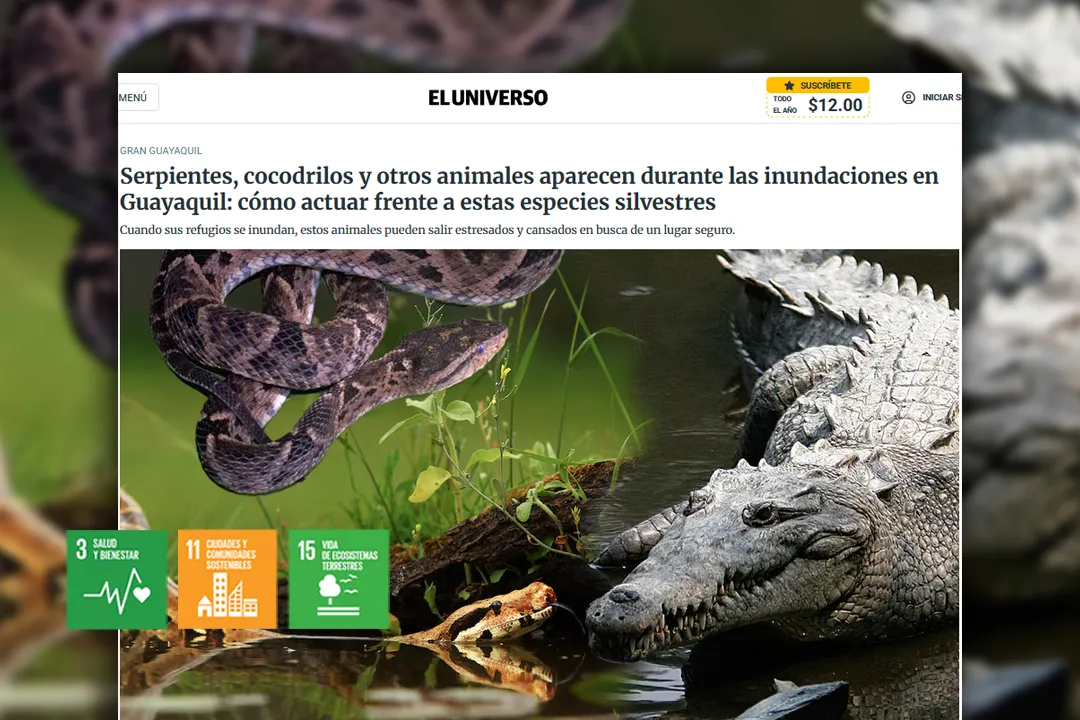


During periods of intense rainfall and spring tides in Guayaquil, overflowing water bodies frequently force wildlife to flee their natural habitats. In response to rising urban sightings, biologist and research professor at the Faculty of Life Sciences (FLS-ESPOL), Julián Pérez Correa, provided scientific insight into wildlife behavior and outlined citizen safety protocols.
The polytechnic expert explained that when habitats become submerged, animals are typically exhausted, disoriented, and stressed as they search for dry, secure ground; their objective is survival, not aggression. "We must emphasize that the real danger is not the animals themselves, but how we react to them," Pérez stressed, noting that bites occur almost exclusively when specimens feel cornered or threatened.
Among the species requiring the greatest caution are venomous snakes of medical importance, notably the equis or fer-de-lance (Bothrops atrox / Bothrops asper, marked by distinctive X-shaped dorsal patterns) and coral snakes (Micrurus spp., characterized by fossorial habits and small jaws). Regarding boa constrictors (Boa constrictor), he noted that while non-venomous, they can exceed two meters in length and cause severe lacerations and secondary bacterial infections if mishandled. In neighborhoods adjacent to the Estero Salado estuary or Parque Lago (Chongón reservoir), sightings may include the American crocodile (Crocodylus acutus) or the spectacled caiman (Caiman crocodilus), alongside freshwater turtles and fishes such as armored catfishes in flooded streets.
The researcher pointed out that human-wildlife encounters are significantly more frequent in urban zones bordering protected forests—such as Prosperina, Cerro Blanco, Cerro Azul, and Cerro Paraíso—a dynamic exacerbated by persistent urban sprawl encroaching on natural ecological corridors.
If encountering displaced wildlife, Pérez urged the public not to attempt capture, feed, harass, or harm the animals, but rather to keep a safe distance and allow them to move on if outdoors. If an animal is trapped or enters a residence, citizens should report the incident immediately to emergency services via ECU 911 to dispatch specialized rescue units from the Ministry of Environment, the Environmental Police (UPMA), or the Municipal Environmental Directorate.