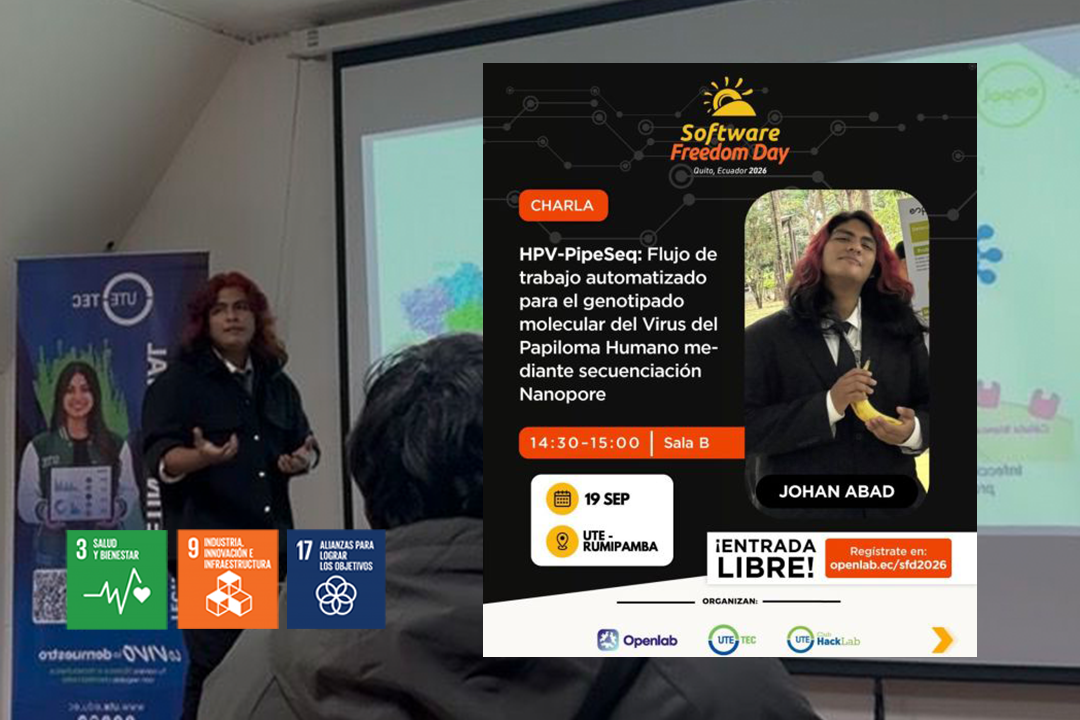


On Saturday, September 19, 2026, Ecuador's capital hosted Software Freedom Day Quito 2026, an event organized by the Openlab Foundation to discuss and promote the role of open technologies and free software in scientific and societal progress.
Within this technological forum, Johan Abad, an undergraduate student at the Faculty of Life Sciences (FLS-ESPOL), delivered a technical lecture titled HPV-PipeSeq, presenting a bioinformatics pipeline engineered to streamline and optimize the genotyping of Human Papillomavirus (HPV) from high-throughput third-generation sequencing data generated on the Oxford Nanopore platform.
Throughout the presentation, Abad addressed the structural and virological foundations of HPV, the biophysical principles behind nanopore long-read sequencing, and the automated algorithmic workflow executed by the pipeline. This computational approach accelerates the bioinformatic screening and typing of viral variants with high accuracy and analytical reproducibility.
The development of HPV-PipeSeq was carried out at the Laboratory for Biological Assays and Diagnostics (ENBIDIA) at FLS-ESPOL, representing a firm milestone in establishing the facility as a leading hub for bioinformatic innovation and computational biology development in Ecuador. The project reaffirms ESPOL’s commitment to open science and the development of accessible, open-source technological tools for diagnostic surveillance and public health.