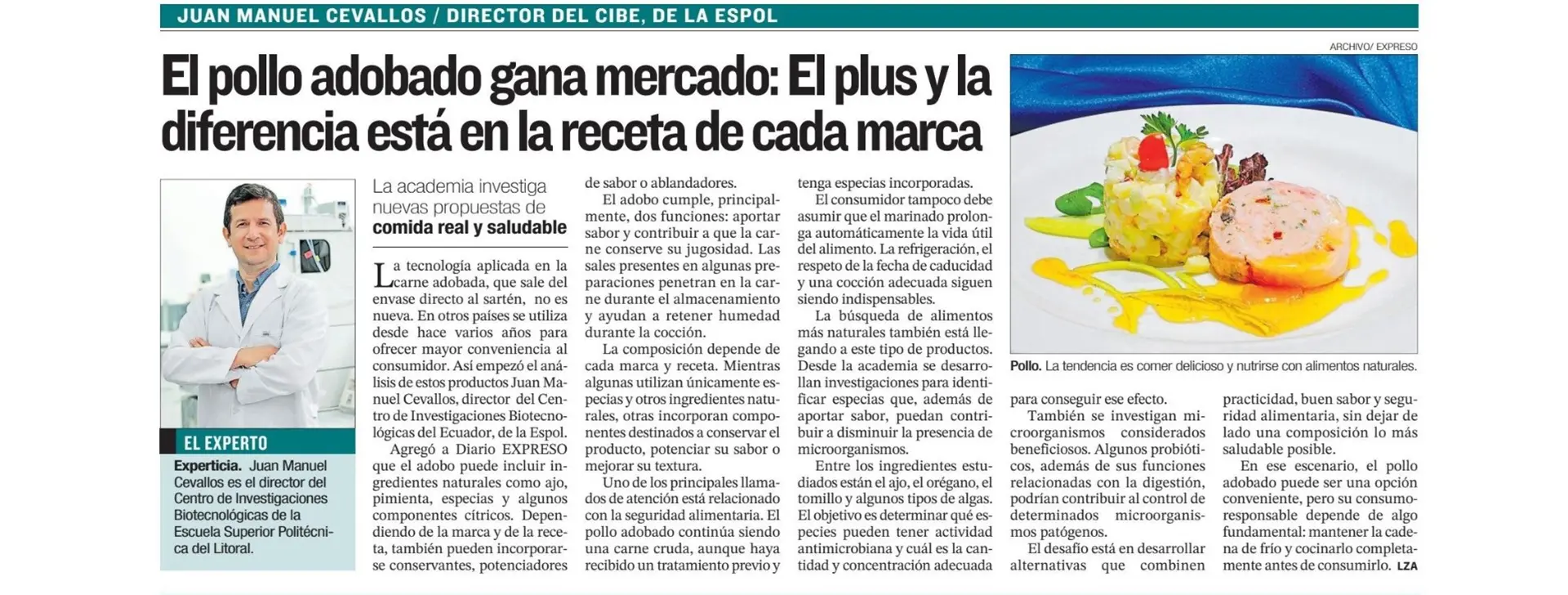



The convenience food sector continues to expand across Ecuadorian households. Among these innovations, seasoned, pre-marinated chicken stands out—designed to go straight from package to pan, offering culinary convenience for consumers.
In an interview with Diario Expreso, Juan Manuel Cevallos, professor at the Faculty of Life Sciences (FLS) and director of CIBE-ESPOL, explained that marinating serves two essential functions: enhancing the meat's flavor profile and improving moisture retention during cooking through salt penetration during storage. However, the specialist clarified that product formulations vary considerably by brand, ranging from natural recipes based on garlic, pepper, spices, and citrus to industrial formulations incorporating synthetic preservatives, tenderizers, or flavor enhancers.
Cevallos issued a direct food safety warning regarding product handling: seasoned poultry remains raw meat. Consequently, consumers should not assume that spices or marinades automatically prolong commercial shelf life. Maintaining strict refrigeration, observing expiration dates, and ensuring thorough cooking remain non-negotiable practices to prevent foodborne illness.
On the scientific front, Cevallos leads research initiatives focused on identifying natural antimicrobial compounds to replace synthetic additives:
Spices and plant extracts: Evaluating garlic, oregano, thyme, and specific types of algae to determine precise concentrations that inhibit microbial growth without compromising sensory profiles.
Beneficial microorganisms: Investigating probiotic applications that, in addition to supporting gut health, deliver biocidal control against pathogens within food matrices.
The convenience food sector continues to expand across Ecuadorian households. Among these innovations, seasoned, pre-marinated chicken stands out designed to go straight from package to pan, offering culinary convenience for consumers.
In an interview with Diario Expreso, Juan Manuel Cevallos, professor at the Faculty of Life Sciences (FLS) and director of CIBE-ESPOL, explained that marinating serves two essential functions: enhancing the meat's flavor profile and improving moisture retention during cooking through salt penetration during storage. However, the specialist clarified that product formulations vary considerably by brand, ranging from natural recipes based on garlic, pepper, spices, and citrus to industrial formulations incorporating synthetic preservatives, tenderizers, or flavor enhancers.
Cevallos issued a direct food safety warning regarding product handling: seasoned poultry remains raw meat. Consequently, consumers should not assume that spices or marinades automatically prolong commercial shelf life. Maintaining strict refrigeration, observing expiration dates, and ensuring thorough cooking remain non-negotiable practices to prevent foodborne illness.
On the scientific front, Cevallos leads research initiatives focused on identifying natural antimicrobial compounds to replace synthetic additives:
Spices and plant extracts: Evaluating garlic, oregano, thyme, and specific types of algae to determine precise concentrations that inhibit microbial growth without compromising sensory profiles.
Beneficial microorganisms: Investigating probiotic applications that, in addition to supporting gut health, deliver biocidal control against pathogens within food matrices.