

In rural areas across Ecuador, small-scale farming, livestock, and brewing operations generate significant volumes of organic solid waste, such as poultry manure, cattle manure, and barley brewing by-products, that frequently lack adequate waste management infrastructure. Rather than being mere "trash," these organic streams represent an unexploited reservoir of nutrients that, when left unmanaged, can drive odor nuisance, pest propagation, and greenhouse gas emissions.
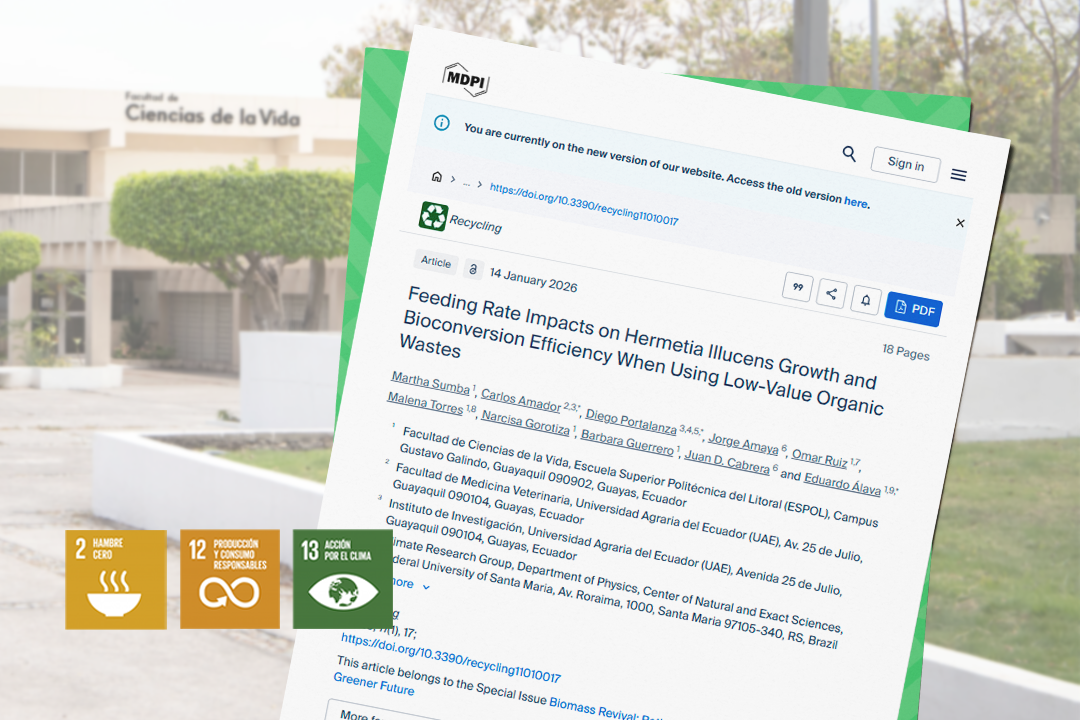
To address this challenge, a research team featuring the active participation of faculty members from the Faculty of Life Sciences (FCV) at ESPOL, Eduardo Álava, Narcisa Gorotiza, and Malena Torres, published the scientific study titled“Feeding Rate Impacts on Hermetia Illucens Growth and Bioconversion Efficiency When Using Low-Value Organic Wastes” in MDPI’s journal Recycling.
Tiny Allies with High Bioconversion Power
The research analyzed the biological performance of a native Ecuadorian strain of the black soldier fly (Hermetia illucens), a non-pest insect species whose larvae exhibit a remarkable ability to consume organic matter and convert it into high-value protein and lipid biomass suitable for animal feed.
To identify optimal rearing conditions under local natural parameters, the researchers evaluated larval growth across three low-value agro-industrial residues supplied at three daily feeding rates (50, 100, and 150 mg per larva per day).
Key Insights for the Ecuadorian Agricultural Sector
The findings revealed that substrate nutritional composition and feeding rates are decisive factors for bioconversion efficiency:
- Top-Performing Substrates: Poultry manure and barley by-products emerged as the most suitable diets. At an intermediate rate of 100 mg/larva/day, larvae attained their highest dry weights (more than double that of cattle manure treatments) and reached harvesting maturity in just 35 days.
- Substantial Waste Reduction: Larval bioconversion achieved significant waste mass reductions, reaching up to 52.9% for brewing by-products and 43.5% for poultry manure.
- The Cattle Manure Constraint: Due to high fiber levels and lower accessible nutritional density, larvae reared on bovine manure required up to 91 days to complete development and achieved poor bioconversion efficiency (<0.8%), indicating that this substrate requires pre-treatment or blending for practical bioconversion.
This research demonstrates that insect-based bioconversion provides a viable, low-cost biological solution for rural waste valorization in developing regions, reinforcing ESPOL’s commitment to sustainable circular bioeconomy models and the regeneration of agricultural soils through nutrient-rich biofertilizers.