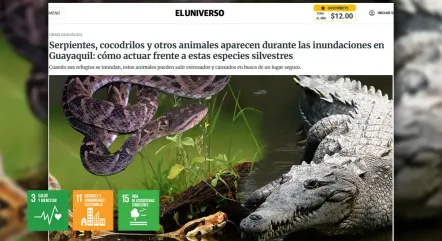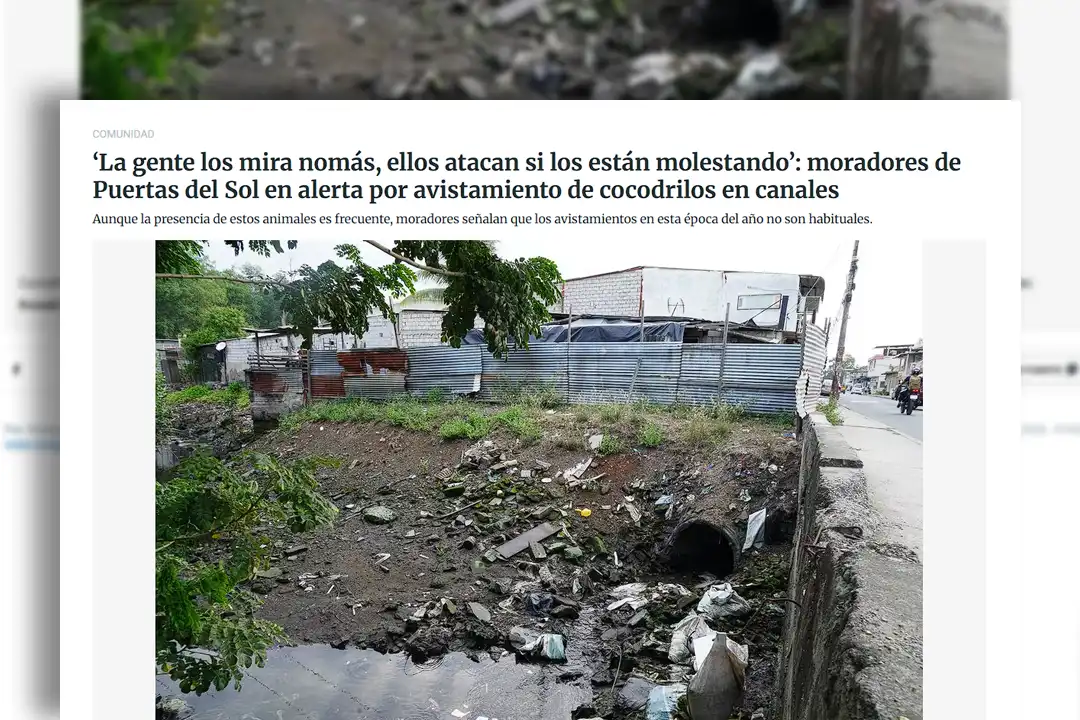

Neighborhood concerns near kilometer 8.5 of Vía a la Costa raised questions about whether the presence of these animals was driven by climate anomalies. In response to these inquiries, biologist and FLS-ESPOL research professor Julián Pérez clarified that these sightings are not necessarily tied to the onset of climatic events like El Niño, as the species has historically inhabited the tidal channels and mangrove branches of Guayaquil.
Pérez explained that the true driver behind the rise in human-wildlife encounters is urban expansion, as residential developments have steadily encroached upon the boundaries of their natural habitat:
"It is important to emphasize that crocodiles, per se, are not inherently dangerous," the researcher noted, pointing out that this reptile plays an indispensable ecological role as an apex predator in the food web and in sustaining mangrove ecosystem health.
He did, however, specify that heavy rainfall and the resulting rise in water levels can make it easier for these individuals to expand their roaming range across drainage channels and waterways.
How to Distinguish Crocodiles from Caimans
The FLS professor also shared key morphological criteria to help the public properly differentiate between the two species:
- Snout shape: The crocodile's snout is narrower and V-shaped, whereas a caiman's snout is broader and more rounded (U-shaped).
- Visible dentition: When the jaws are closed, the crocodile's large fourth lower tooth remains visible, unlike in caimans.
- Size: Crocodiles typically reach substantially larger dimensions.
Finally, Pérez cautioned that the native species along Guayaquil's coastal zone is the American crocodile (Crocodylus acutus), not the caiman. However, he warned of the unauthorized presence of artificially introduced caimans in areas like Parque Lago, which constitutes an additional ecological disruption.
Academia advises residents to keep a safe distance, refrain from harassing the animals, and report sightings to competent authorities to promote safe, harmonious coexistence.