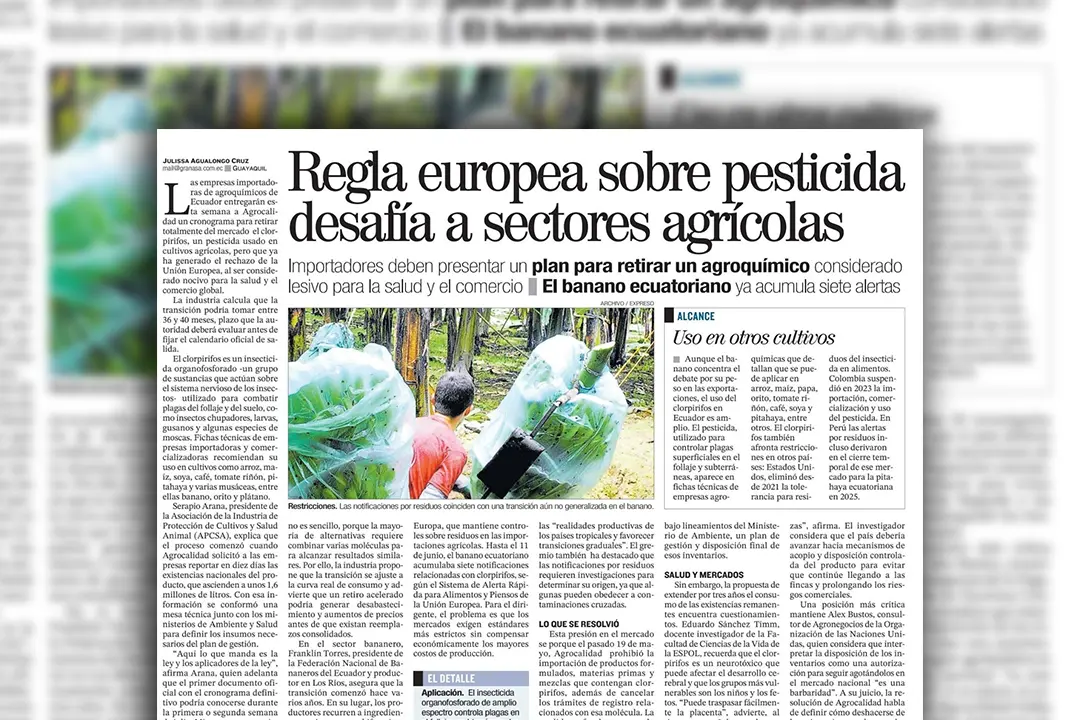

The recent ban on chlorpyrifos issued by Ecuador's Agency for Phytosanitary and Zoosanitary Regulation and Control (Agrocalidad)—which barred the importation of formulated products, raw materials, and mixtures containing this compound following its listing under the Stockholm Convention—has sparked widespread debate among authorities, export associations, and the agrochemical industry regarding the timeframe needed to clear inventories from the domestic market.
Responding to industry proposals to phase out remaining stockpiles over an extended period of up to three years, Eduardo Sánchez Timm, professor and researcher at the Faculty of Life Sciences (FLS) and CIBE-ESPOL, highlighted the immediate toxicological risks of prolonging this organophosphate's presence in the environment. Sánchez warned that chlorpyrifos is a potent neurotoxin that impairs brain development, with children and fetuses being the most vulnerable populations. "It can readily cross the placenta," the expert stressed, also noting the chemical's persistence in household dust and indoor surfaces.
On the trade front, Sánchez emphasized that allowing farmers to deplete existing pesticide reserves will keep jeopardizing agricultural shipments destined for strict international markets, such as the European Union, where Ecuadorian bananas have already triggered food safety alerts due to trace residues. "As long as it continues to be sold, we will keep finding traces," he noted.
As a technical alternative, the ESPOL researcher urged the country to channel its efforts toward secure collection schemes and controlled disposal of the agrochemical, preventing its continued distribution across farms and curbing ongoing public health and commercial liabilities.