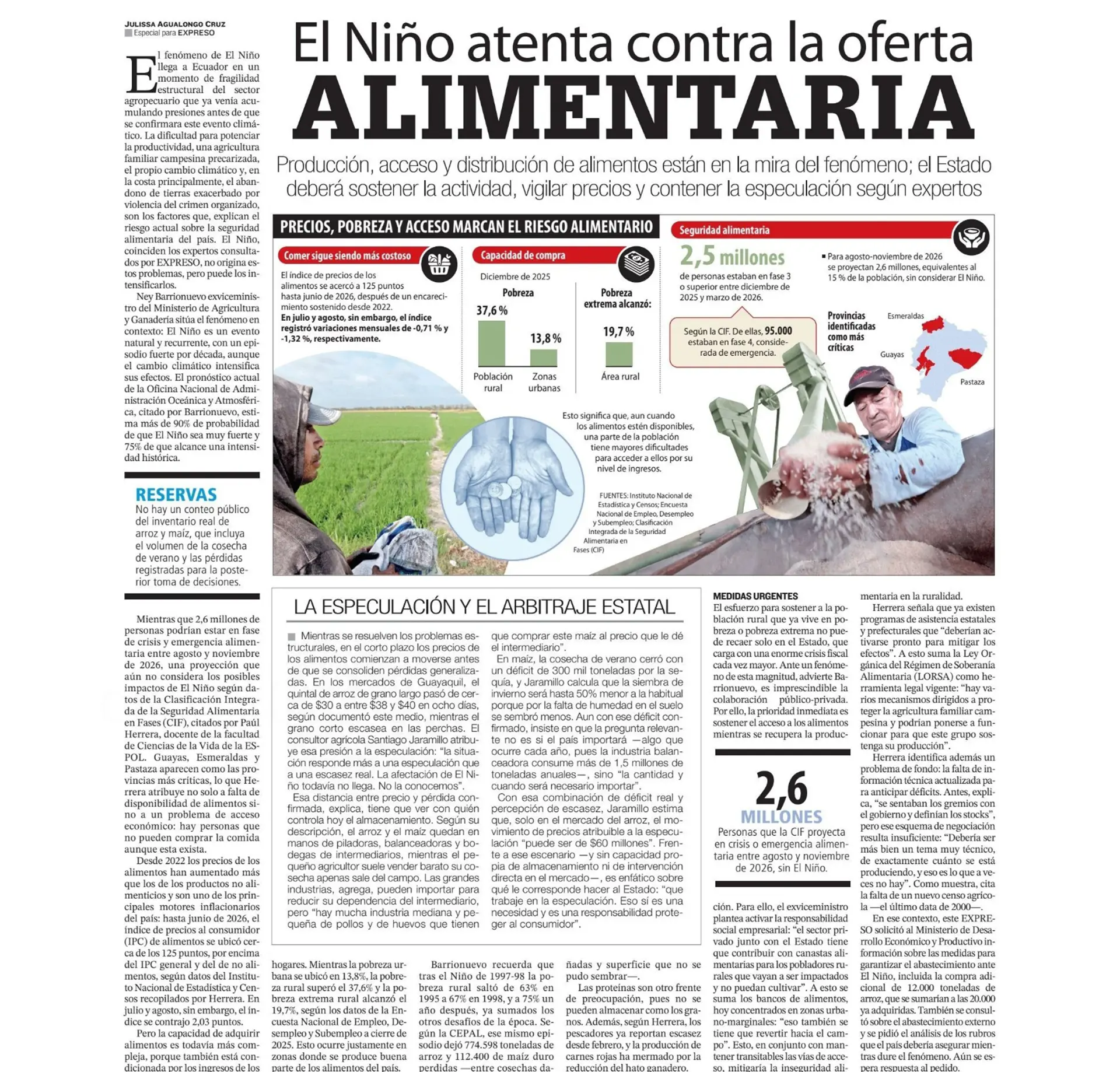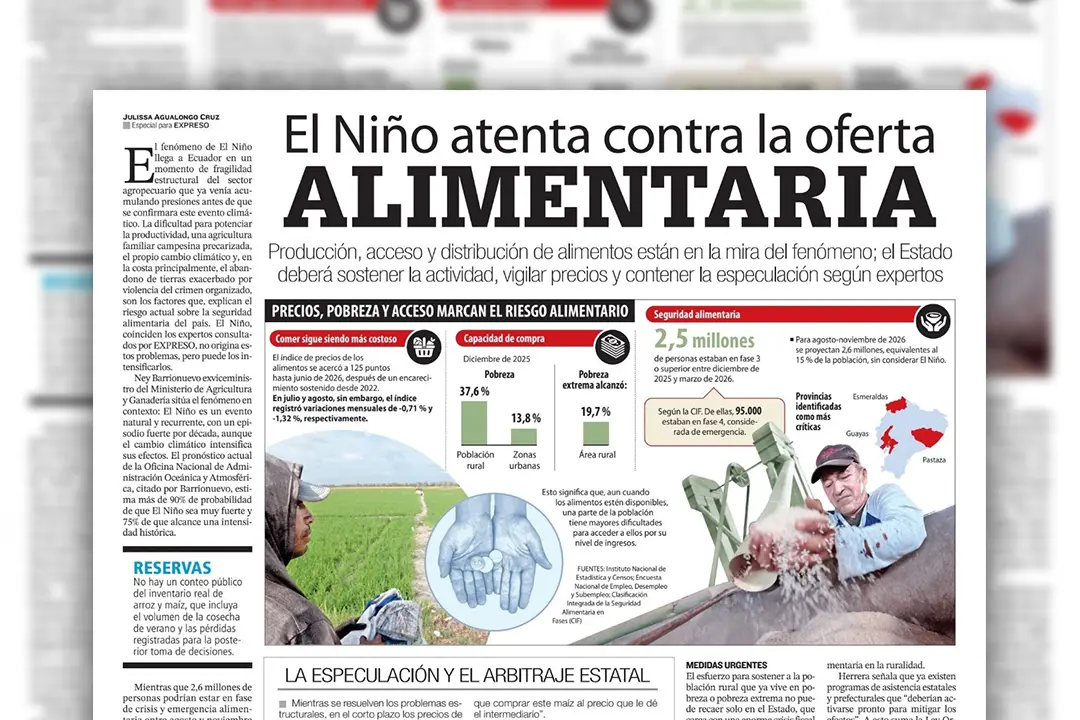


The imminent arrival of the El Niño climate phenomenon places Ecuador's agricultural sector in a state of high structural vulnerability. Within this framework, projections from the Integrated Food Security Phase Classification (IPC) warn that approximately 2.6 million people could face crisis and emergency phases of food insecurity between August and November 2026—even before factoring in the direct toll of the climatic event.
Addressing these projections, Paul Herrera, professor at the Faculty of Life Sciences at ESPOL, identified Guayas, Esmeraldas, and Pastaza as the country's most critical provinces. The specialist clarified that this scenario is not driven solely by physical shortages of food, but primarily by socio-economic access barriers: many families simply lack sufficient income to purchase the basic food basket, even when market shelves remain stocked.
Herrera also raised concerns regarding protein availability. Because protein sources cannot be stored long-term without adequate preservation infrastructure, he warned that artisanal fishers are already struggling to go out to sea due to adverse ocean conditions. This challenge is further compounded by a contraction in red meat supply resulting from shrinking livestock herds.
Technical Data Deficits and Legal Frameworks
The FLS researcher emphasized that a root issue in government decision-making is the absence of reliable, up-to-date technical data:
Lack of recent agricultural censuses: He explained that the absence of a modern national agricultural census (the last one was conducted in 2000) hinders the country's ability to quantify actual field yields accurately and prevents technically sound forecasting of food deficits.
Enforcement of the LORSA framework: He highlighted the applicability of the Organic Law of the Food Sovereignty Regime (LORSA), which provides legal mechanisms to shield family and smallholder farming. These tools should be mobilized swiftly alongside national and provincial assistance programs to sustain rural output.
The ESPOL scholar’s analysis underscores the necessity of pairing protection policies for smallholder farmers with rigorous statistical data collection to deter price speculation and safeguard the nation's food sovereignty.